



Back in Print: From Wardrobe to Walls
For generations, Maison Martin Morel’s patterns were made to be worn. Founded near Lyon in 1896, the family textile house closed in the 1980s, taking thousands of designs with it. Three decades later, descendant Emmanuel Foyatier brought them back, this time as wallpaper. We speak with him about reopening the family archive and deciding what a century of patterns should look like today.
By İzlem Arsiya
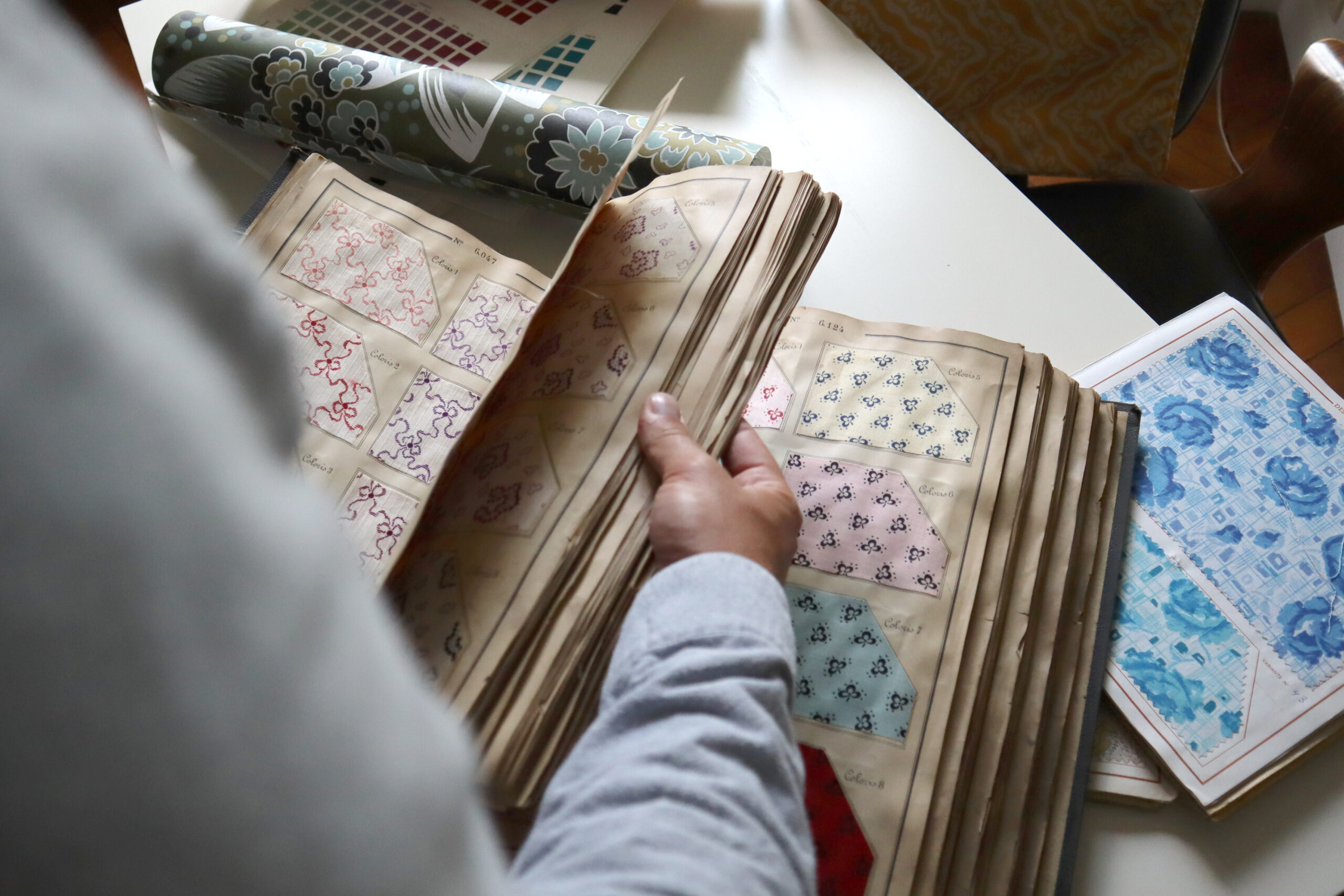
Maison Martin Morel began near Lyon in 1896, printing textiles for fashion through generations of changing colour, taste and style. When the company closed in the early 1980s, the Morel family inherited thousands of patterns – an extensive archive of drawings, gouaches, fabrics and pattern books spanning almost a century.
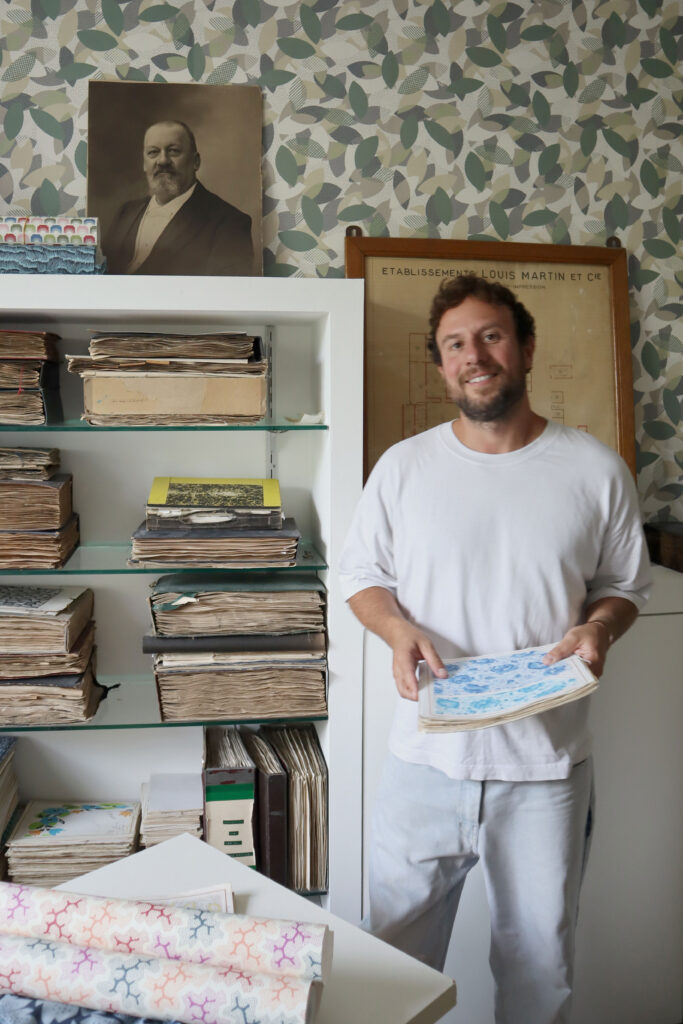
The Maison had been part of Emmanuel’s life long before he thought of reopening it. “My grandparents still lived next to the factory, and their house had direct access to the old offices,” he remembers. “We used to play ping-pong next to the old workers’ time clock. With my cousins, we would steal the keys to the offices to play hide-and-seek. For us children, it felt like a real expedition.”
Printed textiles were everywhere, from cushions and table linens to fabrics around the family home. Yet the company itself was rarely discussed. Its closure had been a painful chapter for Emmanuel’s grandfather, and the family had naturally moved on. “So I grew up surrounded by it without really knowing it.”
For more than thirty years, the patterns sat untouched. Then, in 2013, Emmanuel brought the Maison back to life. Patterns were recoloured, resized and reassembled. Motifs once designed to be worn began appearing across walls and contemporary interiors.
When did you first realise there might still be something in the archive?
Emmanuel Foyatier: At the time I was living in New York and my roommate was a textile designer. She worked for a New York company that collected vintage patterns and presented them to creative directors as sources of inspiration for their collections.
I told her that my family had once owned a textile company in France and that, if she wanted, I could have a look at what fabrics we still had.
So you went back to the factory?
EF: Yes. No longer to hide there with my cousins, but to look at the fabrics. And that was when I realised the incredible richness of the collection. All these treasures were simply sleeping on the shelves.
What did you see in them that you hadn’t before?
EF: A small flower, a stripe, a strange geometric shape… each one seemed to contain the beginning of something else.
I think this is when I really fell in love with patterns. I realised they are not only decoration. They can carry an emotion, an atmosphere, even a memory.
A pattern can have a surprisingly long life. It can begin on a drawing table, become a dress, disappear into an archive for decades, then return at a completely different scale and in a completely different context. Along the way, ideas of what looks good change too. Colours fall out of fashion and find their way back in. A floral firmly associated with another decade can suddenly feel current again.
Not everything about the patterns survived with them. The archive contains thousands of documents, but surprisingly little information about many of them.
“Sometimes there is a date, a reference number, a fabric sample or an indication of a colour, but very often there is no designer’s name and no story,” Emmanuel says.
At first, he wanted those missing pieces back. Now, he has come to appreciate the mystery. “The patterns have almost become independent from their authors. They live by themselves. And perhaps that also leaves some space for us to imagine their stories again.”
With thousands of patterns to choose from, what makes you stop at one and decide to bring it back?
EF: What fascinates me is that one pattern can have almost endless possibilities. You can change the scale, the colour, the material, combine it with another motif… and suddenly it becomes something completely different. I like looking at the archive not only for what a pattern is, but for what it could become.
Is it an instinctive choice?
EF: I think I also choose patterns for what they make me feel. Some have something joyful, others are quieter or more mysterious. A pattern can amuse you, surprise you, calm you, sometimes even comfort you. It can take you somewhere else, to another period, another place, without being literal about it. I love that.
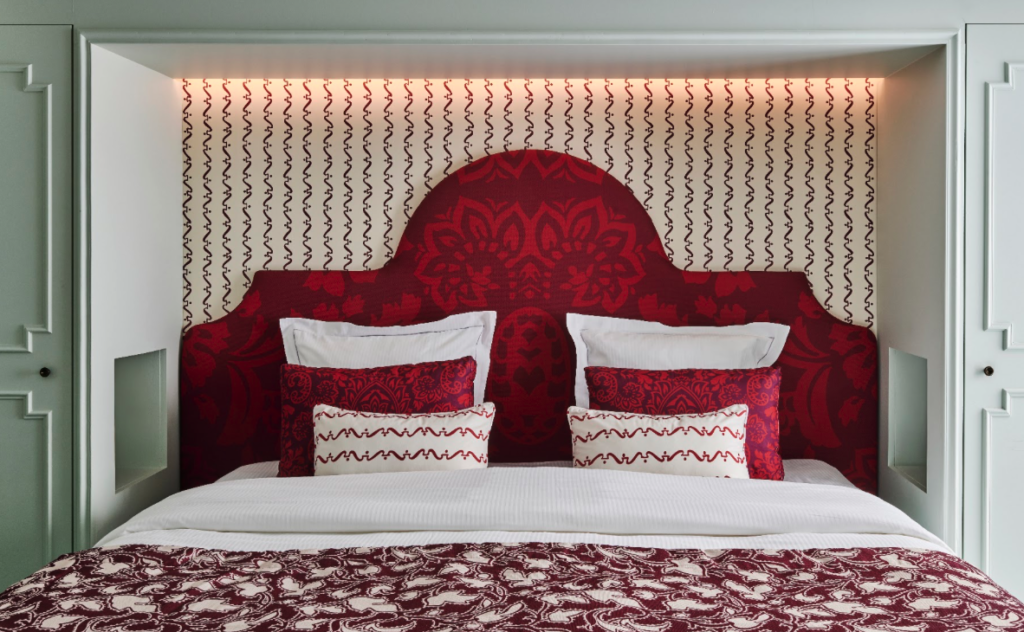
Sometimes, the project itself determines where in the archive to look. For Hôtel Brighton in Paris, Emmanuel worked with Thibaut Picard on patterns connected to the end of the 19th century, when the hotel first opened. Rather than selecting a single design, they created a family of patterns that could work together across wallpaper, upholstery and carpet.
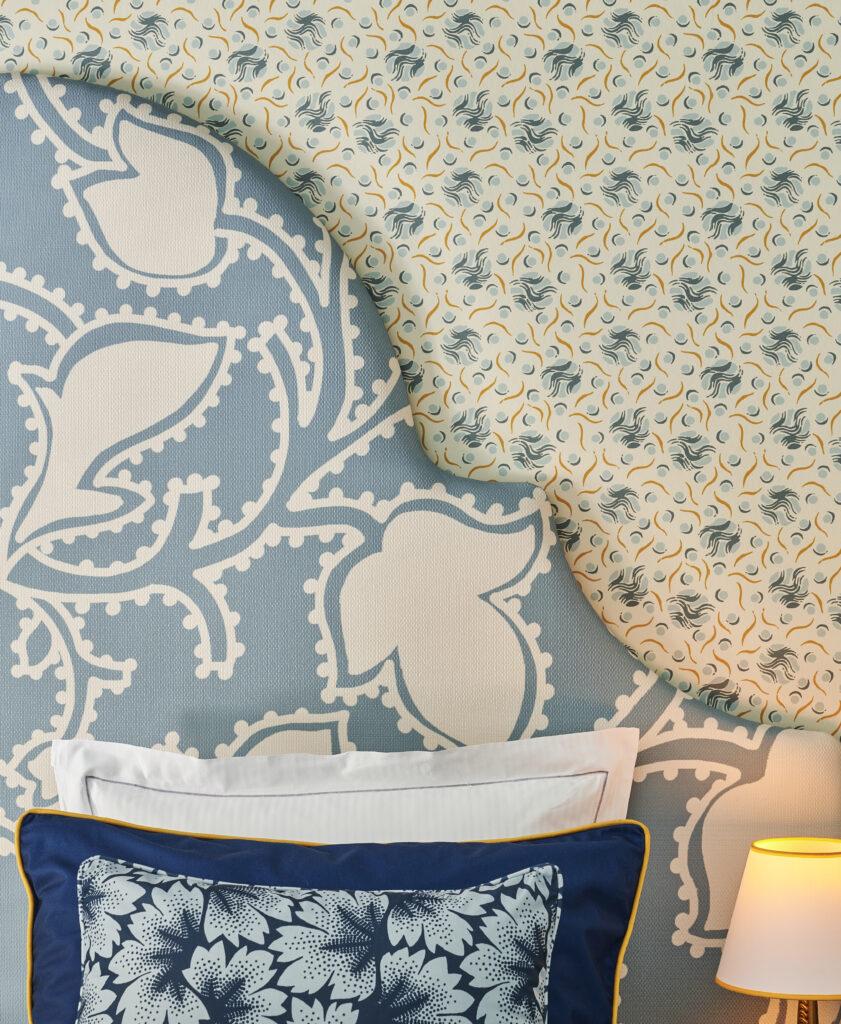
Other times, the archive leads the way. While developing Amarante with Carole Doreau, they came across a group of paisleys from around 1912 that felt so close to her universe that, as Emmanuel puts it, “the collection almost started by itself.”
Working with the archive means making decisions its original designers could never have anticipated. Which patterns deserve to return? How much can an original be changed? What happens when something created by one generation lands in the hands of another?
And once you’ve chosen one, how much are you willing to change it?
EF: I don’t think respecting an archive necessarily means reproducing it literally. For me, what needs to survive is not necessarily the exact drawing, but its character, and perhaps also the emotion it carries.
Some patterns require very little change. For the murals, we often isolate certain elements from the archives, redraw them, combine several different sources and add new elements.
Have you ever taken one too far?
EF: Yes, sometimes we go too far. We work on something and eventually realise that all the tension, or all the strangeness that made the original interesting, has disappeared. We may have made it more accomplished, more polished, but also more ordinary.
When that happens, I usually go back to the original document. The archives have their own way of putting you back on the right path.
The biggest transformation, however, has been one of scale. Designs created to move across dresses and fabrics now cover entire rooms.
What changes when a pattern moves from the body to a wall?
EF: Scale changes everything. A pattern designed for a dress is seen in movement and always in fragments. On a wall, you suddenly discover its architecture. The repeat becomes much more important.
Do all textile patterns make good wallpaper?
EF: Some very small textile patterns become incredibly graphic when enlarged. On the other hand, some designs that are beautiful on a piece of fabric can suddenly become almost overwhelming once they cover a wall.
And what does pattern do to a room?
EF: What really interested me was discovering how much life a pattern can give to a room. A room can be perfectly beautiful and still feel a little asleep. A pattern can wake it up. It gives it a presence, sometimes even a personality.
The archive has also given Emmanuel a rather extensive view of changing taste. He is still surprised by “the modernity of some very small graphic or textured patterns from the early 1900s,” the radical geometry of the 1930s and the exuberance of colour in the 1960s.
“Every period had its own audacity, its own idea of beauty.”
Taste is never fixed for long. Something that feels strange or old-fashioned can disappear, wait a few decades and suddenly speak to us again. As Emmanuel puts it, “patterns have their own life.”
Now, his work has become another layer in that life. The archive he inherited will eventually contain his own decisions, colours and reinterpretations too.
What would you want someone to do with all of this a hundred years from now?
EF: More than anything, I would like them to keep having fun with it.
So you wouldn’t want today’s designs to become untouchable?
EF: I would hate for the archive to become something frozen or untouchable.
I hope they allow themselves to change the colours, change the scale, cut the patterns apart, mix them with other things and make them completely part of their own time.
Is there anything you would want them to preserve?
EF: The only thing I would want them to keep is the spirit behind it: the same sense of elegance, the same demand for quality, and the same desire to create emotion and atmosphere through pattern. Everything else can change.
More than a century after the first Martin Morel patterns went into production, they are back in print, only now the wardrobe has become the room. The archive keeps changing hands, scales, colours and contexts, with no particular expectation that it should remain exactly as it was found.
For Emmanuel, that seems to be the point: “Not to recreate the past, but to allow some of its beauty and emotion to become part of our lives today.”
