

Two Ways of Holding
At Milan Design Week, among a week of objects designed to last, Studio Yellowdot presents EDIBLE REVERIES in collaboration with ARTISIA.
There, sitting on a pedestal at Via Melzo 34, is a piece of pasta. It is the size of a coin. It was kneaded by hand, printed by machine, and shaped by code. Pick it up and it tells you how to hold it.
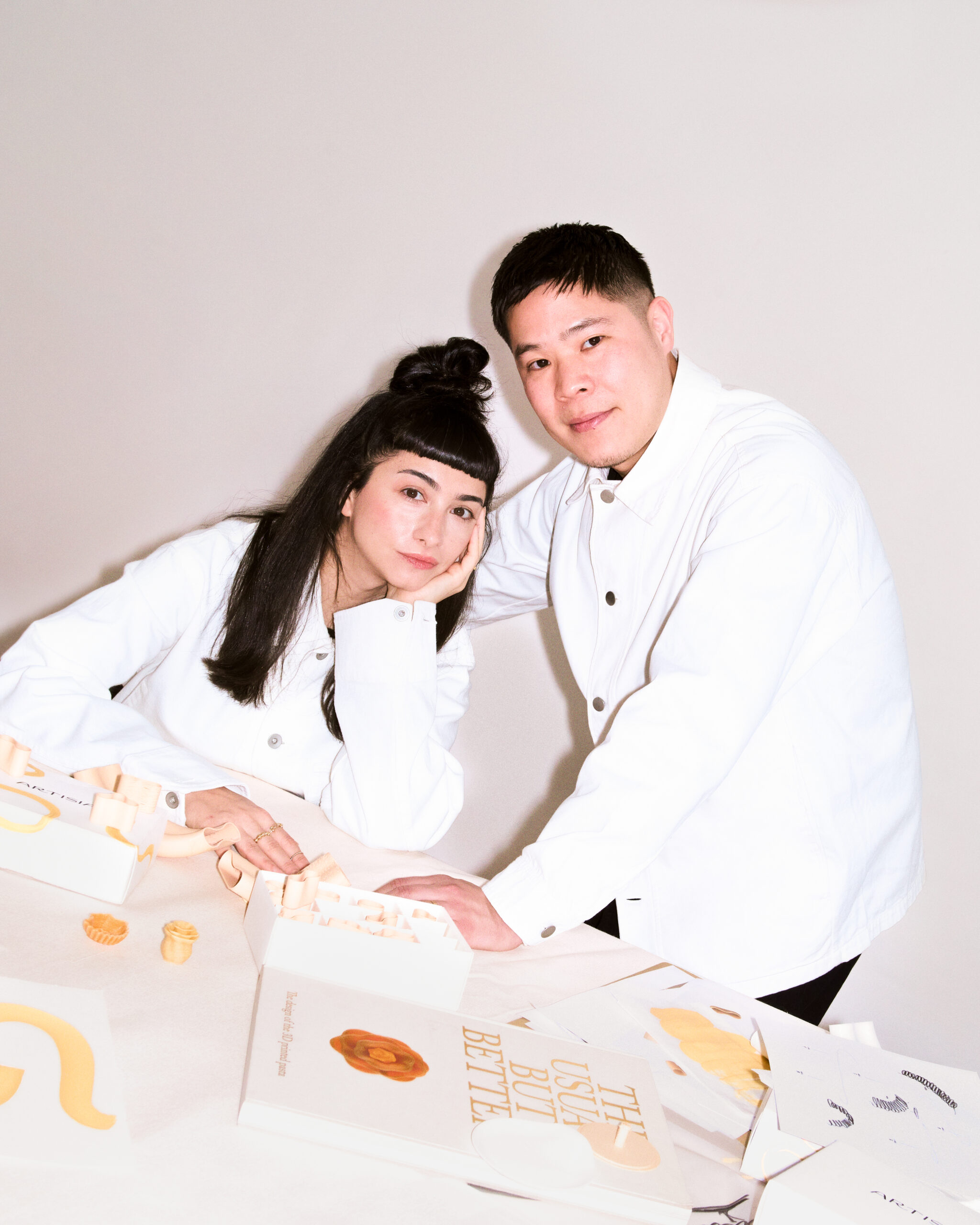
That precision comes from two different ways of understanding the body, meeting in a single object. We spoke with Bodin Hon and Dilara Kan Hon, founders of Studio Yellowdot, to find out how.
by Anamaria Roa
Ways of Working
Bodin Hon began as an engineer, designing life-support systems for astronauts at NASA Johnson Space Center, where failure is not an option.
“Designing for environments where every interaction must be anticipated, where systems are tested against failure, introduces a different kind of discipline,” he says. “Not expressive, but exact.” His work depends on control, on knowing exactly how an object behaves once it meets the body.
“Ceramics, textiles, metalwork: practices where the hand remains central.” Dilara Kan Hon‘s words, and the world behind her approach.
She studied at Marmara University before continuing at Istituto Europeo di Design, splitting time between Istanbul and Milan, between studios where making and thinking are closely tied. Her approach is less about control and more about sensitivity, as the studio describes it: “That proximity to material, to repetition, to touch, sits closer to Dilara’s way of working.” How something feels before it is understood.
At Studio Yellowdot, those two ways of thinking sit side by side. Bodi and Dilara first met at the Istituto Europeo di Design in Milan, where their contrasting backgrounds began to find a common language. A collision of opposites, where logic meets emotion. “We always carry both ways of thinking with us,” they say. “But sometimes being in one place makes you more aware of what the other is missing. That’s when we push our collaborators in different directions — to unlock something they might not normally reach.”
This week they have one of the most talked about installations at Milan Design Week 2026.
Edible Reveries
“Reveries” means daydream or a state of dreamy meditation. “Edible Reveries,” then, roughly translates to daydreams you can eat.
The title, the studio recalls, was never chosen so much as discovered. “While developing the installation, we were searching for a mood for the music — something slow and atmospheric. Soft atmospheric piano was the mood, Debussy’s Rêverie was one of the melodies playing in the background, and it clicked for our team.” The rest followed naturally. “The idea of ‘edible daydreams’ felt like the closest way to describe all the elements that were emerging together.”
The project unfolds across two scales.
In the hand, it appears as a single piece of pasta. “The pasta form carries small indentations, guiding the grip without instruction. It echoes hand-pinched dough — an instinctive gesture translated into something computed. What feels natural is carefully resolved,” Bodin and Dilara reflect. “What feels intuitive is constructed.”
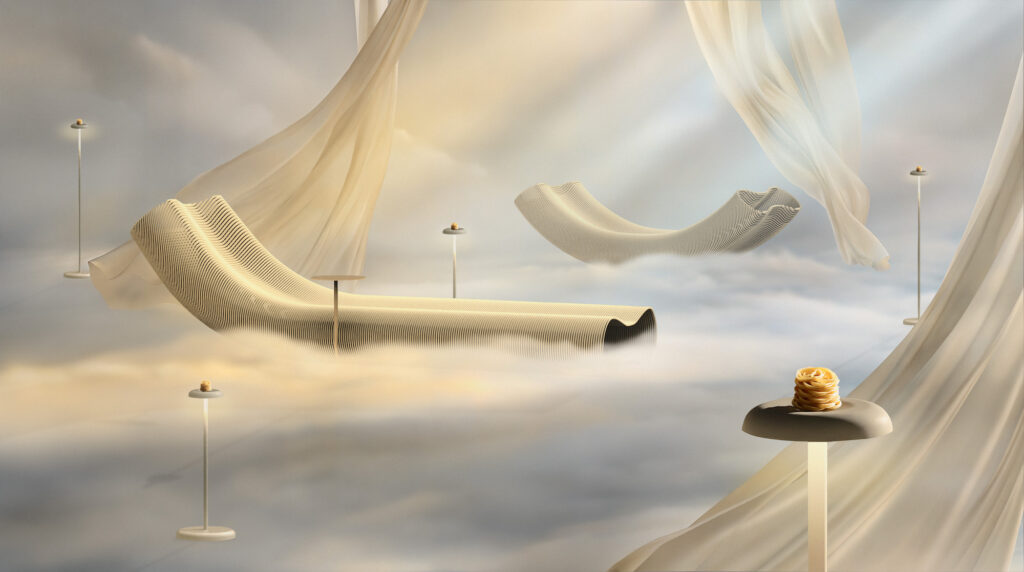
In the room, it becomes furniture. “For the exhibition furniture, we began with the scenario first. We imagined a moment — something slow and familiar, like being by a pool, next to a fireplace, or simply daydreaming. From there, the form appears almost as a continuation of that state.”
Both scales are shaped by the same line of thinking.
A daybed, a rocking chair, a chaise longue, all produced through robotic 3D printing with LAMÁQUINA. The subtle indentations that once respond to fingers are reinterpreted to support the full body. “It’s a shift from precision at the fingertip to precision at a bodily level.”
A projection traces the movement from digital model to physical object. A low soundscape runs through the space. Tastings bring the work back to the hand, pairing the pasta with non-alcoholic aperitifs developed with Cantina Pizzolato. The installation rewards time spent in it.
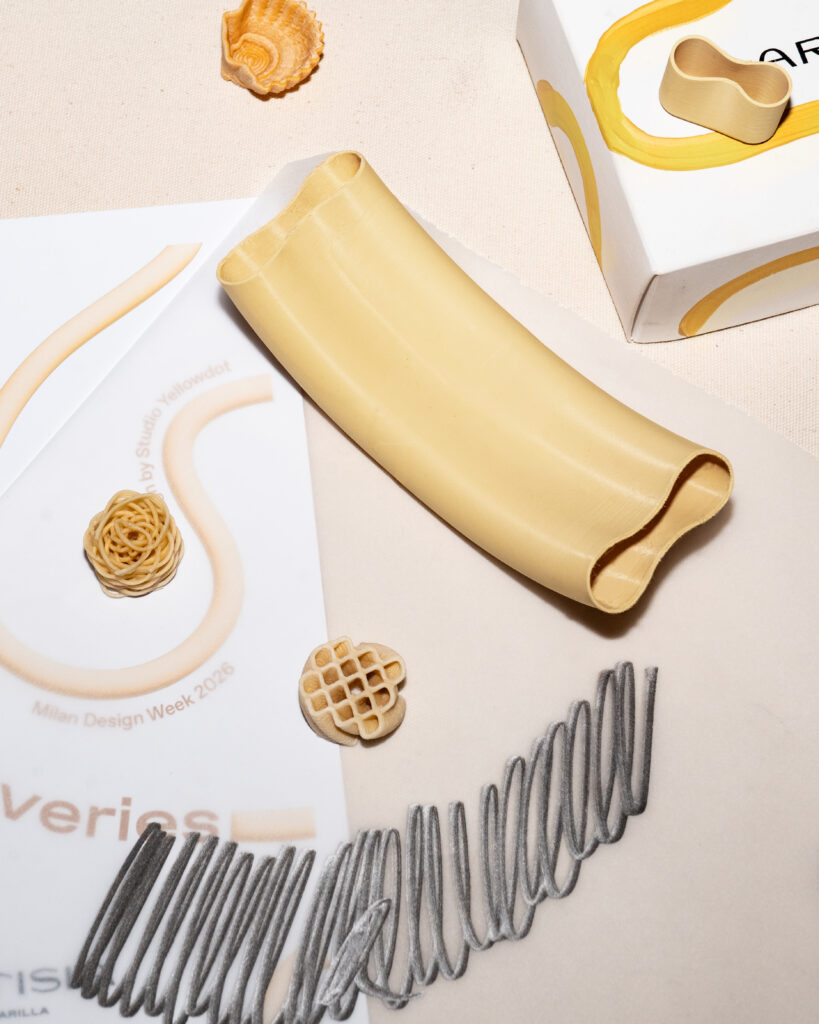
ARTISIA’s pasta starts where all pasta starts. Semolina and water. The recipe is as old as the ingredient. What happens next is not.
“It was very hands-on from the beginning,” say Bodin and Dilara. The pasta, titled Tattile, begins as a digital model. Its geometry is adjusted not only for how it looks, but for how it will be held. Where the fingers land. How the object turns. How it disappears in a single bite. “We started with cooking the 3D-printed pasta they gave us to experience them as home cooks. Later, after the idea came, we moved to soft clay to understand volume and behaviour,” they continue, “then into 3D printing for precision and refinement. But the hand was always present in the process.”
What surprised them was how the work continued to evolve after production. Once cooked, the pasta expands by around 30%, becoming softer and more elastic. “That shift became part of the design,” they reflect. “Later the chef would add their personal touch, so it is infinitely evolving.”
And then it ends.
Once eaten, the object disappears, which for Studio Yellowdot is almost the point. “In a context that often celebrates permanence, EDIBLE REVERIES moves in the opposite direction,” say Hon and Kan Hon. “It slows things down, intensifies the moment, and then lets it end. There’s something honest in that disappearance.”
Across both, the work returns to a shared concern: how an object meets the body, and what happens in that moment.
